Few Summers is a project that started from a feeling rather than a product idea. I build with AI every day, so it is easy for me to picture the moment when a child asks for a minute and a parent answers "in a minute" without looking away from the screen. The golden time when children are small slips through your fingers because you are building the future, and in that future the house will one day be quiet. Few Summers is a series of short animated films about exactly that feeling. Each lasts a few dozen seconds, is vertical, and is meant to end with a sting and one decision from the viewer: close the laptop. The series is published on Instagram as @fewsummers and is made entirely in a faceted 3D world I built in Blender.
The name of the series is a decision too. "Few summers" means a few years, but literally a few summers: the number of holidays when a child still wants a parent to push the swing. Counted that way, it turns out not to be an endless resource. That simple arithmetic is the heart of every episode, and the name reminds you of it before you watch the first frame. The captions and lines are in English, because the story is universal and builder parents live all over the world.
The promise of a single feeling
Before a single scene existed, I defined what the viewer should feel. I wrote it down as the channel's promise: every film must evoke one feeling, that time with small children passes faster than it seems. The viewer is a builder, a founder or a developer with young kids. They should recognise themselves in the film, feel the sting and step away from the desk.
Just as important was what the series does not do. It does not moralise and it does not show a bad father. The dad loves his family and works for them; the tragedy is time, not him. I rejected a preachy form because people defend themselves against accusations but open up to a story in which they see themselves. If the dad were a villain, the viewer would say "that is not me" and scroll on. A good dad who keeps postponing the moment is a mirror that is hard not to look into.
The world and the characters
The series has fixed characters and fixed places, because repetition builds recognition. The dad is a builder who sits in a cave full of monitors working with AI agents; he has a top knot and a beard, so it is easy to guess where his look came from. The mum is the warmth of home, the daughter has red braids, freckles and always a yellow flower, and the youngest, a baby, does not speak yet but laughs and takes first steps.
The places matter too. The cave is cold and blue, full of screens and humming servers. A chasm with a footbridge separates the dad from his family. A meadow at golden hour, a tree with growth marks and a swing, and a campfire under the stars are the world the dad might miss. Motifs keep returning: the yellow flower a child gives, which the dad accepts or misses; an empty swing rocked by the wind; growth marks on the tree; excuses like "later" and "one more feature"; and the laptop lid, whose closing is a choice. The seasons show the passage of time better than any caption could.
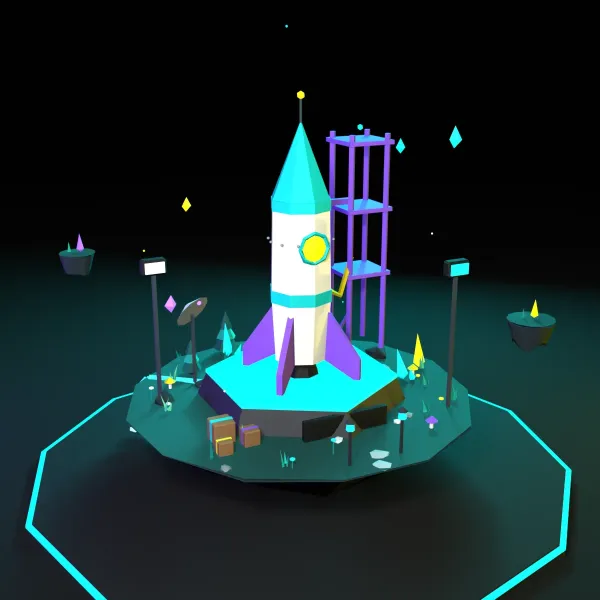
The look of the world is a deliberate decision. I chose a faceted style, flat irregular faces and warm light, because it has something of a children's book illustration about it while still letting me build entire scenes from code. Realistic characters would fall into the uncanny valley, and overly cartoonish ones would take the gravity out of the story. Facets sit somewhere in between: simple enough to feel tender and refined enough to carry emotion.
The structure of an episode
Every episode follows the same structure, which I wrote down as a rule. The first three seconds are the hook: a child's request or an image of loss from the very first frame, with no black card and no logo. Then the dad's excuse, given without looking up. Then the child waiting, as the sun sets and the flower droops. Next comes a montage of time: seasons, growth marks, an empty swing, and the music comes in. After that the emptiness, when the dad looks up and it is too late. Finally a wake-up or a bitter punchline, and an end card with two short lines such as "Few summers. Don't miss them."
This template is not a limit on creativity but its frame. Thanks to it each episode can focus on one new image and one new excuse, and the viewer knows from the first second which world they are in. Over time I also added rhythm rules drawn from watching finished films: the last shot before the end card lasts at most about two seconds, because a long wordless wide shot is the moment people scroll away, and the end card stays on screen long enough for the punchline to be read calmly.
The two newest episodes, from November 2026, keep this frame while playing with it differently. In "Two minutes" the daughter asks her dad to dance under the tree, and he, eyes on the phone, says two minutes, Claude is almost done. With her hands on her hips she asks what they are supposed to do for those two minutes, and after a beat the dad answers that they dance. In "DADDY.md" the daughter, in the cave full of screens, asks what CLAUDE.md is, meaning the file where you write down rules for an AI assistant. Her dad says it holds his rules. She sounds one of them out: "don't... interrupt... me", steps back and apologises. The dad turns his chair and says: interrupt me, always. In the file he replaces the rule with an exception: unless it's her, and it is always her. I show both episodes higher up the page, under the first section, with the option to switch the sound on.
An episode factory built from code
The technically most interesting part of the project is the episode factory. Every film starts as a screenplay stored in a JSON file: a title, one sentence about what the episode is about, the characters' lines with emotions, music and a list of shots. Each shot states why it exists, where it happens, in what light, with which ambient sound and who is in it. A compiler checks the screenplay and turns it into a description ready for rendering.
One command produces a preview: it generates the voices, assembles the sound, renders the shots and edits a phone version of the film. Further commands produce the final 4K and 1080p versions, the cover and a cinema version with an HDR image for Instagram. I generate the characters' voices with speech synthesis, and every line in the screenplay carries an emotion tag. The factory's most important rule is about time: the renderer recalculates only the shots whose image has actually changed. Each shot's fingerprint covers its description, the voice recordings it uses and the rendering code, so changing the music or the order of shots does not require re-rendering anything. Trimming a shot that runs too long is a single field in the screenplay.
This way of working lets me treat animation like software. A lighting fix in one file carries into every following episode. I can compare two variants of the same frame before deciding on the whole film. I can also work with an AI agent that writes screenplays according to the channel's rules while I review the finished preview and decide what reaches the viewers. A person writes the rules, the machine proposes the screenplay, and the final choice is always mine.
Sound does half the work
In a film lasting half a minute, sound carries at least half of the emotion. That is why every shot in the screenplay has its own ambient sound: a meadow, the edge of a forest, spring, autumn, winter, night, the cave with humming servers or with keyboard typing, the sea, a lake, a city at night, home. The cold cave sounds different from the warm meadow, and the viewer feels that difference before noticing it. On top of that come single effects at a specific moment, such as a whoosh of passing time during the montage of seasons.
Music only comes in during the passing-of-time section, not from the first second. That was a deliberate choice: at the start you should hear the child's voice and the real world, and the music arrives when time begins to slip away. It plays under the end card right to the end, so the punchline has room. Music levels are written in the screenplay, so changing them does not require re-rendering the image.
The factory also prepares each episode's cover: a chosen frame with a large headline and two short sentences beneath, ready to refine in Affinity. The preview goes straight to my phone, because that is where the film will be watched. Many decisions about rhythm, shot length and caption size are only made after watching the preview on a phone, not on a big monitor at the desk.
What was hard
The hardest part was emotion. A faceted character has limited facial expression, so sadness, waiting and joy have to come through pose, gesture, light and the rhythm of the edit. I reworked many shots after watching the film on a phone, because what worked on a big monitor disappeared on a small screen. Captions have to fit within the safe zone of Instagram and TikTok, so the compiler rejects a line that is too wide and requires it to be broken.
The second challenge was scale. As the episodes multiply, manual work stops making sense. Every element I repeated more than twice became a function or a rule: character poses, lighting presets, ambient sounds, end cards. As a result a new episode is mostly a new screenplay rather than a week of work in Blender.
What came out of it and what is next
Today Few Summers has its own world, fixed characters, an episode factory and an Instagram channel. The monk from my Focus Equals Freedom brand grew out of the same world, and the dad became the basis of my own 3D figure on the delta240mvt website. Ahead of me are more episodes and further refinement of the rhythm based on how viewers react to the first seconds. I also want to find out which motifs, the flower, the swing or the marks on the tree, stay in people's memory the longest.
Why this project matters to me
Few Summers is the most personal project in my portfolio. It is about something I face myself: that the excitement of building with AI can take time you will never get back. Making this series reminds me to close the laptop now and then. At the same time it shows how I work: I can turn an emotional story into a system that behaves predictably, and I treat technology as a tool for the story rather than a goal in itself. If even one parent walks out to the swing with their child after watching an episode, the project will have done its job.