Focus Equals Freedom began with a sentence I have carried around for a long time: focus gives you freedom. It is not about productivity for its own sake, but about the idea that whoever is in charge of their attention decides what their life is spent on. In 2026 that sentence became a brand with its own character: an old monk in sunglasses who sits on a rock above a valley and calmly comments on the problems of people living among notifications, AI agents and endless iterations. The brand's line is "Old monk. New problems." and it captures the tone well: a little humour, a little wisdom, no preaching. The project has three parts: reels on Instagram, the focusequalsfreedom.com website, and sound sessions for focus that anyone can use in the browser.
Why a monk and not another guide
I could have written more guides about focus. I decided, though, that when it comes to attention, words easily turn into lecturing, and people are tired of "10 ways to be more productive" lists. A character creates distance. The monk does not tell the viewer what to do. He shares how he sees the world, and the viewer can recognise themselves in it or simply smile. It was a deliberate product decision: a short scene with a character is closer to how people actually watch content on their phones than a long text full of bullet points.
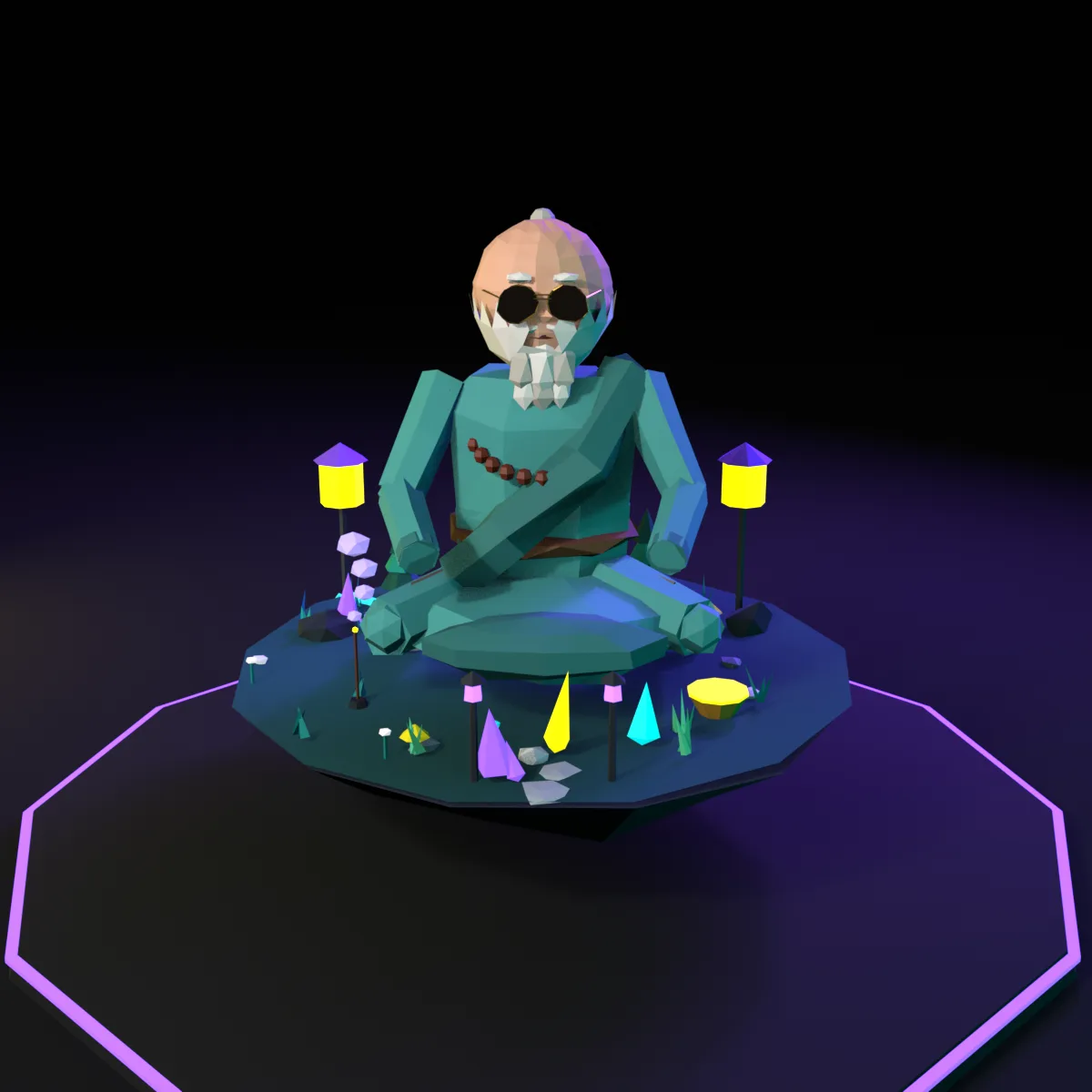
The choice of character was also a visual decision. The monk comes from the same faceted Blender world in which I make my series Few Summers. That meant I did not start from zero: I already had the style, the lighting, the animation rules and the rendering pipeline. The monk got his own rock, valley, mist, aviator glasses and a set of hand gestures, and every reel is a small scene with one thought. The series includes episodes about notifications, about doing one thing at a time, about the morning rhythm, about doing nothing, about whether AI will take people's jobs, and about why it is so hard to sit still.
Reels: one thought, one scene
Each reel has a simple structure: a few sentences from the monk, captions with a highlighted word, a camera that moves with the rhythm of his speech, and a valley in the background that lives a life of its own. The captions are large and legible because most people watch without sound. The first seconds have to stop the thumb, but the punchline always belongs to the monk and his calm.
I render the reels in Blender from code. The scene, poses, facial expressions and camera moves are written in files rather than clicked together by hand. That way a fix in one place, for example better light on the monk's face, carries into every following episode. It is the same principle I apply in digital products: I would rather build a process that can be repeated than achieve an effect once and never be able to reproduce it.
I also spent a lot of time deciding how much monk each reel should have. The first versions had more words and more camera movement, yet they were harder to watch. When I cut his lines to a few sentences and left silence between them, the scene started to breathe. I carry the same lesson into client work: fewer elements, each with a clear job, almost always beats an effect added just because it can be. For a brand about focus it would be strange if its content were distracting.
The two newest reels, from November 2026, show this structure in practice. In "The phone" a girl asks the monk whether he has a phone. He answers drily that of course he does, it has been in the waterfall since 2019, and when people ask how he finds time, he says he does not find it, he stopped giving it away. In "Sit still" the girl asks whether AI can meditate. The monk says the machine cannot sit still for a single second, and adds: neither can you. The machine answers in a millisecond, a person in two. The machine was built that way, a person was not. I show both reels just above this section. The captions are burned into the picture, and the sound, meaning the voices, the music and the rush of the waterfall, is switched on with the button in the corner of each film.
A website where the monk comes alive
The focusequalsfreedom.com site went through several versions. An earlier landing page called "Orbit" was abstract and looked great, but it did not tell the brand's story. In November 2026 I replaced it with "Monk", a page that leads you through the world people know from Instagram. The hero is the monk on his rock above the valley, split into layers: valley, mist, the monk with his rock, and a light overlay. As you scroll, the camera moves closer to the monk and day turns into night. Then come the monk's five teachings, where his gesture changes with each sentence, an "Attention → Agency → Freedom" strip, a session picker, the sound tool, a reel from Instagram and a closing card.
I built the motion with GSAP and its ScrollTrigger, and the smooth scrolling with Lenis. When the system is set to reduce motion, nothing animates and the content is visible straight away. The page deliberately loads no web fonts and uses the system typeface, because every extra request slows the first screen, and here first impressions count. The images of the valley and the monk are Blender renders saved as WebP and graded the same way as the reels.
The part I like most is the player. Instead of a flat icon it holds the whole monk in real 3D, exported from Blender to glTF. You can turn him with a finger or the mouse. A tap brings out the next artifact with one of his lines: a phone falling apart, a lotus, a halo, an AI orb, levitation or butterflies. During a session the monk moves according to its character and the rhythm of the sound: in focus he is still and looks at the user, in relaxation he sways gently, and in sleep he fades along with the light. I later used the same mechanism, a Blender model you can turn in the browser, in the delta240mvt shop.
I show the same monk at the top of this page, next to the project facts. It is the same model as on focusequalsfreedom.com, rebuilt in code in Blender for this site's theme: the head is a separate part pivoting at the neck, so on a computer the monk turns it to follow your cursor, and the "Meditate" button lights a violet halo behind him. You can also turn the model by dragging it. With reduced motion turned on in the system the monk stays still, and on weaker hardware, with data saving on or without WebGL, only the still image remains.
Sound built from measurements
The third part of the project is a sound lab: a generator of five binaural sessions called Focus, Relax, Sleep, Astral and Astral Calm. Here I made the decision I am proudest of. Instead of guessing parameters, I analysed recordings I had listened to myself (the app does not use them; its sound is generated from scratch): channel spectra, pairs of left and right ear frequencies, loudness envelopes over time. Based on that I chose the frequency pairs for each session, while the proportions, noise and phases are my own design. The analysis reports describe what I reproduced and what the synthesis does not recreate.
The engine schedules the whole session on the Web Audio clock rather than on page animation, so the session does not depend on whether the tab is visible. The output has headroom, a limiter and a gentle saturator, and the default volume is 35 percent. On iPhones the app requests a system playback session so it can work in silent mode, and it supports the Media Session API with the title and description of the current session. Astral Calm adds a space slider, pink noise and an optional slow "enveloping" movement of the sound.
You cannot judge sound by ear alone, so I built tests for it. Scripts render the sessions offline and check that every sample is a valid number, that the peak stays below a set threshold even in the loudest configuration, and that real silence remains once the sources stop. Separate browser tests check starting on a user gesture, fast switching, pausing and resuming, and the variant without WebGL. That way every change to a preset goes through the same check before it reaches the website.
Just as important was what I do not promise. The sessions are an artistic proposal that supports rest and focus, not a guarantee of any particular state or a treatment. The visualisation is an artistic model, not a measurement of brain waves. The app does not upload audio, has no accounts and collects no analytics. The only thing stored in the browser is the light or dark theme choice on the privacy page.
What was hard
The hardest part turned out to be reconciling three worlds: 3D animation, scroll-driven effects and sound that has to stay clean for half an hour. Browsers limit the number of WebGL contexts, so I kept track of how many run at once and check it with an automated test. Audio behaves differently after the phone is locked depending on the iOS version, so instead of promising it will always keep playing, I added a resume button and described the limitations clearly.
The second difficulty was the character himself. The monk had to be funny and trustworthy at the same time. Every adjustment to his face, glasses or gesture meant checking the scene in several shots, because what works in a close-up can vanish in a wide one. The player started from the open-source pjt222/gateway project, whose author declares the MIT licence, but little of the original remains: the interface, the sound engine and the entire visual layer were built from scratch.
What came out of it and what is next
Today Focus Equals Freedom has a series of reels, a website with the monk in 3D and five sound sessions available in the browser. The repository also holds Android and iOS app projects waiting for their turn. Ahead of me are new episodes and finding out which of the monk's teachings really resonate with people. I want to measure that through conversations and reactions, not through view counts as the only signal.
An important lesson from this stage was having the courage to throw away something that looked good. The 3D field engine from the previous landing page, the player visualisation and the experimental field preview were removed from the code once the monk replaced them. Keeping them "just in case" would have meant more code to maintain and a slower site. Removing the old design was as deliberate a decision as adding the new one.
The project also shares a common thread with my app Frinter, which I describe in a separate portfolio entry. "Focus equals freedom" was Frinter's motto before it became the name of a brand. Frinter helps you record where your attention goes, and the monk reminds you why it is worth caring about in the first place.
Why this project matters to me
Focus Equals Freedom is a project where all of my skills meet at once: character and story, Blender, website code, sound and keeping promises honest. It shows that I can go from a single sentence to a coherent world with its own aesthetic and the technology that delivers it. It is also personal. I need this monk more often than I would like to admit: when yet another iteration with AI pulls me in late in the evening, he reminds me that freedom does not come from doing more, but from choosing what I give my attention to.